
Most contractors only offer 5-inch gutters. Westbrook now installs 7-inch and 8-inch K-style seamless gutters — and for many Georgia homes, the difference is significant.
If you've ever watched water pour over the edge of your gutters during a heavy Georgia rainstorm — sheeting off the roof in a curtain instead of flowing through the downspout — you already know the problem. Your gutters can't keep up.
For most homes, the answer isn't cleaning the gutters more often. It's installing gutters that are actually sized for the job.
Westbrook Roofing and Remodeling is now one of the few contractors in the metro Atlanta area offering 7-inch and 8-inch K-style seamless gutters. Here's why that matters, and how to know if your home is a candidate.
The Standard 5-Inch Gutter Was Designed for a Different Era
The 5-inch K-style gutter has been the residential standard for decades. It works fine on smaller roofs in moderate climates. But Georgia isn't a moderate climate — and a lot of homes in the metro Atlanta area aren't small.
The problem is volume. A 5-inch gutter can handle roughly 1.2 inches of rainfall per hour across a standard roof section. That sounds like plenty until you're dealing with a summer thunderstorm that drops 2 to 3 inches in under an hour — which happens regularly in Walton, Newton, Rockdale, and Gwinnett counties.
When a gutter is overwhelmed, water doesn't just overflow. It backs up under the shingles, saturates the fascia board, pools against the foundation, and erodes the landscaping you spent money on. Over time, that overflow causes the exact kind of damage gutters are supposed to prevent.
What 7-Inch and 8-Inch Gutters Actually Do Differently
The jump from 5-inch to 6-inch gutters increases water-handling capacity by roughly 40%. The jump to 7-inch increases it by about 80%. An 8-inch gutter can handle more than double the volume of a standard 5-inch system.
That's not a marginal improvement. For the right home, it's the difference between a gutter system that works and one that fails every time it rains hard.
7-inch K-style gutters are ideal for:
- Homes with larger roof footprints (over 2,000 square feet of roof surface)
- Steep-pitched roofs that shed water faster
- Homes surrounded by trees that accelerate debris buildup and restrict flow
- Any home that has experienced chronic overflow with standard gutters
8-inch K-style gutters are typically used for:
- Very large residential roofs
- Commercial or semi-commercial buildings
- Homes with complex rooflines that concentrate runoff into specific valleys
- Properties where foundation protection is a high priority
In both cases, the gutters are fabricated on-site as a single continuous piece — no seams, no joints, no weak points where leaks develop over time. That's what "seamless" means, and it's the only type Westbrook installs.
Why Most Contractors Don't Offer Them
If larger gutters work better for many homes, why doesn't every contractor offer them?
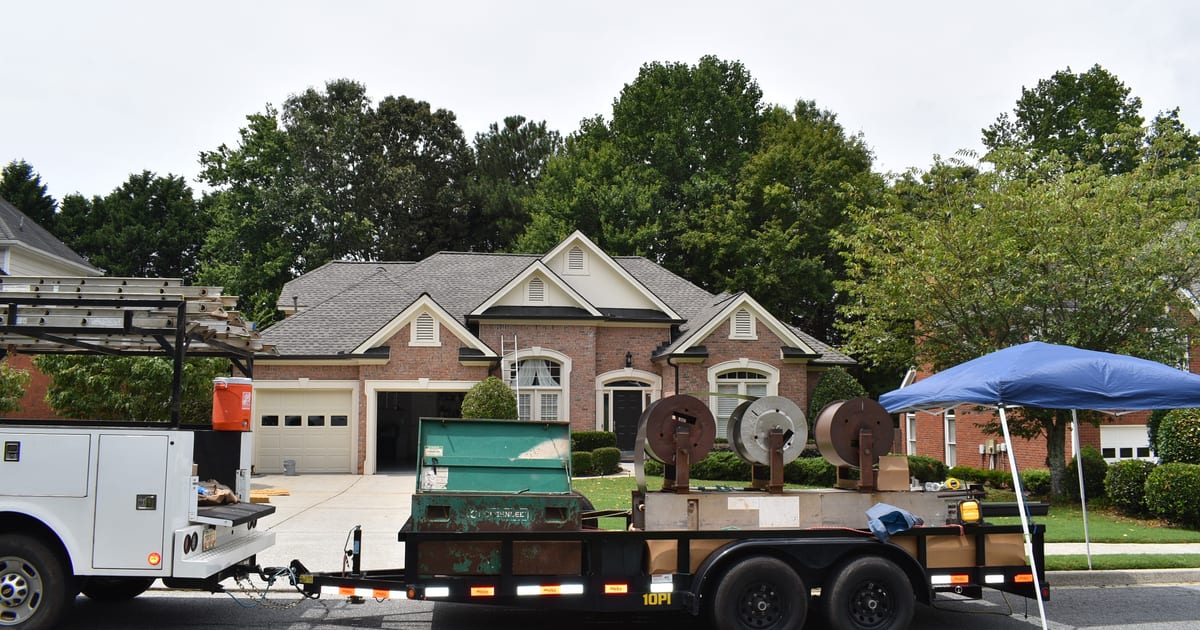
The honest answer is equipment and training. Fabricating 7-inch and 8-inch seamless gutters requires a different roll-forming machine than the standard 5-inch and 6-inch equipment most gutter companies own. It's a capital investment most smaller operations haven't made, and it requires the crew to be trained on the different material handling, hanger spacing, and slope requirements that come with larger profiles.
It's easier to sell a homeowner a 6-inch gutter and call it an upgrade than to actually invest in the equipment and expertise to go bigger when the job calls for it.
Westbrook has made that investment. When your roof and rainfall patterns call for 7-inch or 8-inch gutters, we can install them — fabricated on-site, custom-fit to your home, with the same seamless construction we use on every job.
How Georgia's Rainfall Makes This More Important Than You Think
Georgia averages about 50 inches of rain per year — more than Seattle, more than Chicago, more than New York City. And unlike those cities, Georgia's rain tends to come in intense bursts rather than steady drizzle.
The National Weather Service regularly records 1-to-2-inch-per-hour rainfall rates during summer convective storms across the metro Atlanta area. In those conditions, a 5-inch gutter on a large or steep roof isn't just undersized — it's essentially decorative. The water is going over the edge regardless.
Add in the region's heavy tree canopy — pine needles, oak leaves, sweet gum balls — and you have a recipe for gutters that clog quickly and overflow even faster. Larger gutters don't eliminate the need for cleaning, but they provide significantly more margin before a partial clog becomes a flooding event.
What to Look For on Your Own Home
You don't need to be a contractor to spot the signs that your gutters are undersized. Walk around your home during or right after a heavy rain and look for:
- Water pouring over the front lip of the gutter rather than flowing to the downspout
- Erosion channels in the mulch or soil directly below the gutter line
- Staining or rot on the fascia board behind the gutter — a sign of chronic overflow and splash-back
- Foundation dampness or basement moisture on the side of the house where gutters overflow
- Gutters pulling away from the fascia — often caused by the weight of standing water that never drains fast enough
Any one of these is worth a conversation. All of them together means your current gutter system is actively damaging your home.
The Seamless Difference — Why It Matters Regardless of Size
Whether you need 5-inch, 6-inch, 7-inch, or 8-inch gutters, the seamless fabrication process matters as much as the size.
Sectional gutters — the kind sold in pre-cut lengths at home improvement stores — have joints every 10 feet. Every joint is a potential leak point. Over time, the sealant at those joints breaks down, the metal expands and contracts with temperature changes, and the seams open up. You end up with gutters that drip along their entire length rather than channeling water to the downspout.
Seamless gutters are fabricated from a single continuous coil of aluminum, cut to the exact length of your roofline on-site. There are no interior seams — only the end caps and downspout connections, which are properly sealed and far less prone to failure than mid-run joints.
The result is a gutter system that lasts longer, leaks less, and requires less maintenance over its service life.
Getting the Right Size for Your Home
Gutter sizing isn't one-size-fits-all. The right choice depends on your roof's square footage, pitch, and drainage pattern — as well as your local rainfall intensity and the tree coverage around your home.
When Westbrook provides a free estimate, we assess all of those factors and recommend the gutter size that's actually right for your home — not just the size that's easiest to install. If your home is a candidate for 7-inch or 8-inch gutters, we'll tell you why and show you the difference in capacity.
If a 5-inch or 6-inch system is the right call, we'll tell you that too. The goal is a gutter system that works, not the most expensive option on the menu.
Call us at (770) 466-4681 or request a free estimate online. We serve Loganville, Monroe, Covington, Conyers, Snellville, Lawrenceville, and all of metro Atlanta — and we'll bring the gutter machine to you.
Explore Topics
Written by
Westbrook Roofing and Remodeling
Content creator and writer sharing insights and stories.